$4,500 in savings. $2,500 repair. I still had to stop investing.

Early morning, my phone rang. A call from a mechanic talking about my car’s transmission. Once I heard “transmission” I already pictured a big payment. I mostly skipped the explanation until he reached the number, $2,500. I had $4,500 in my savings account, two months of expenses. I figured that was enough to start with. I had read articles and Reddit threads telling me that having something saved was better than nothing. But I didn’t know how bad it could actually be. I had never experienced it, never expected, and nothing I had read had prepared me for it.
What actually upset me wasn’t the $2,500 payment. It was realizing what could have happened without having an emergency fund at all, or if the accident had been bigger. I would have ended up in a bad situation – cutting on food, reconsidering moving somewhere cheaper, suspending investing indefinitely, and digging into credit cards. If the car broke down again, or I needed an unexpected visit to the doctor, that money would be gone for good.
I thought investing early was much wiser than building an emergency fund. So I was consistently investing $400 a month before the car repair. But I had to stop investing to rebuild my emergency fund.
On the other hand, stopping investment felt bad, it felt counterproductive. Why would I stop investing money where over time it would mostly grow, and put it somewhere with almost no return just to feel safer? Investing and research had become a hobby I enjoyed. It was so satisfying and rewarding to see a 19% return, looking at the brokerage account balance and seeing real results. This price to feel safer felt like a big tradeoff. One I knew was right in the long term, but I couldn’t justify it enough for myself.
Ultimately it was hard to argue with the numbers – $2,000 and monthly expenses still to be paid. I decided to stop investing and focus on rebuilding my emergency fund. I couldn’t afford another car repair that would hit me hard.
I was definitely more careful with spending in the weeks after, cutting anything that wasn’t necessary. I was in a bad position: money sitting in a brokerage account and growing, while I barely had enough to cover basic needs if anything went wrong.
Two months of expenses definitely wasn’t enough when almost half of it had to go to the transmission repair. This forced me to rethink how I approached the idea of an emergency fund. For me it had always been optional, a supplementary step that was nice to have. I researched how to determine the right emergency fund amount, and where to keep it.
So I did some math and figured that my $2,200 monthly spending would require a $6,600 emergency fund for 3 months and $13,200 for 6 months. I set the goal to hit 4-5 months of expenses, or roughly $10,000. If I had another car repair or an unexpected doctor visit, I wouldn’t get that much stress and panic.
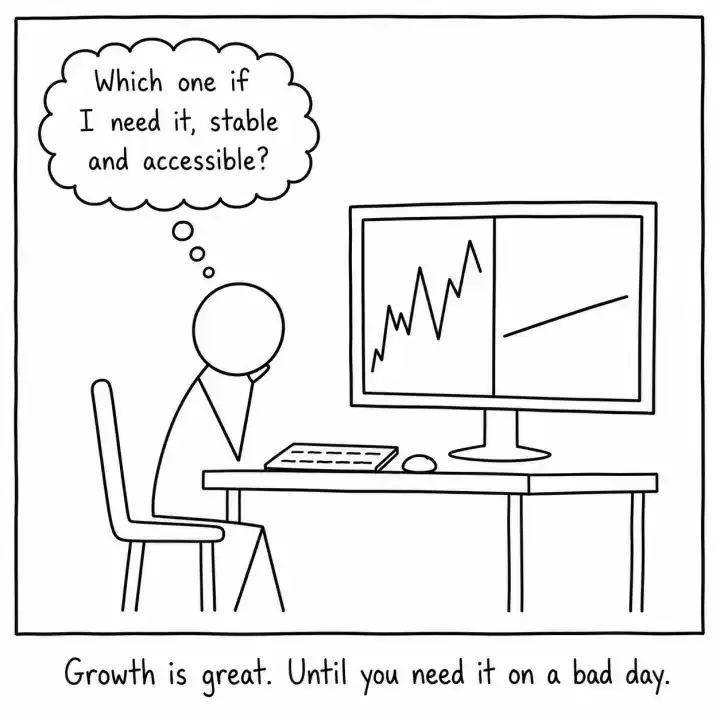
I researched some options for keeping an emergency fund. There were a variety of choices. However, I wanted my $10,000 to make a profit while sitting and doing nothing – my investments were doing so, why couldn’t the emergency fund do the same? So a regular checking account wouldn’t work. My brokerage account also wouldn’t be the best choice, as most investments could lose their value overnight and I would be forced to sell at a loss. I would also end up waiting for a transfer to my bank account – in case of an emergency, I wouldn’t have 3-5 business days.
I needed something stable and easy to access. I found that a high yield savings account, or HYSA, works similar to regular savings accounts but provides a higher yield. HYSA was also insured up to $250,000 – which worked perfectly for me.
I researched all legitimate and reputable banks that offered a HYSA and opened one. I slowly started to build my emergency fund month by month, and it took me under a year to hit the $8,000 milestone. At that point I figured I could benefit more by splitting my savings between investing and an emergency fund. $8,000 covered 3.5 months of expenses. A single emergency wouldn’t wipe it. I decided to redirect $200 a month back toward my brokerage account, while the rest kept building toward the $10,000 emergency fund goal.
Once I started building my emergency fund, I noticed the annual percentage yield, or APY, on my HYSA was increasing month by month. When I started it was a little below 2%, and by the time I hit $8,000 it was already around 3.75%. Which meant I’d get around $300 a year just by holding my emergency fund in HYSA instead of a regular savings account, and it was also insured! For my full $10,000 goal, that was $375 a year – three months of car insurance, or enough to cover six oil changes, or a little over my monthly grocery budget.
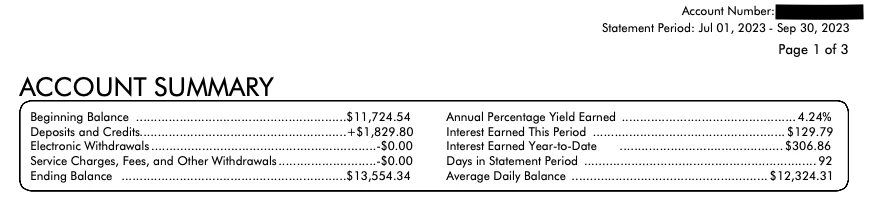
By the time I reached a little over $10,000, the APY had climbed to 4.24%, where it stayed around there for almost half a year. It felt like a big jump. From right under 2% to more than double that. For money that was insured but also stable and accessible, that was exceptional. And I wasn’t even doing anything for it. I didn’t research stocks, I didn’t need to look for financial reports. The money was just sitting there, growing on its own.
But why exactly was the APY rising so fast, from under 2% to 4.24% over roughly a year? I already knew the answer from past experience – it was the Federal Reserve setting interest rates higher to slow down inflation. Read more about why this is important and how you can use it.
I figured 4-5 months of expenses was good, but I ideally wanted to have 8 months of expenses covered. That was my long-term goal. It would give me some safety net and flexibility – if I ever needed to sell other investments, I wouldn’t have to do it immediately. I could do it on my terms.
I didn’t know until the broken car that investing alone isn’t sufficient. I needed to fix how I handled the money I had, as well as how I handled what I spent, before even thinking about investing in the first place.
All this time I thought I was ahead of people by building wealth earlier but I didn’t have the foundation to build it on.
You can use your own numbers to find what your emergency fund should be, and what it would earn just sitting in a HYSA, in the calculator below.
Before you build it
What should your emergency fund actually be?
Run your own numbers – the same math from the article, with your own expenses and rate.
Include everything you’d still owe with no income: rent or mortgage, utilities, groceries, insurance, debt payments, subscriptions.
Check your bank’s current rate – it changes with central bank decisions (the Federal Reserve in the US), so don’t assume it stays the same.
Your emergency fund targets
One article a week. Real numbers, real mistakes, no finance bro nonsense. If you made it this far, you already know if it’s for you.

2 Comments
Comments are closed.