I had a budget. But I didn’t know I was losing $2,400

I was already investing $400 a month and it wasn’t enough. But I wanted to do more. The problem was I couldn’t find where the extra money would come from.
I had a budget and I was following it. I still couldn’t figure out where the money was going. I sat with my bank statements on Sunday looking for large transactions until I saw a $47.25 phone bill. I always assumed it was $30. I thought that was a mistake, so I double-checked the plan summary and it was indeed $47.25.
I went through other categories with a piece of paper and a calculator. My rent was already quite low at $1,050 total with bills and I didn’t consider moving as it would require time investment I didn’t have. Groceries were fine, rice, chicken, basics. Nothing to cut there. Takeout was usually where the money went – mine was already zero. The gas spending was also low because I didn’t need to commute all the time to work. I was working remotely half the time. Online courses were around $40 a month – I kept those, I needed them. Clothing, haircuts, household items – nothing I could reduce.
I kept moving and I found a $27 Apple Store subscription I didn’t use. I thought I had canceled last year. I assumed once I canceled a subscription I didn’t need to double-check it was still active. I didn’t know I needed to check for a final confirmation.
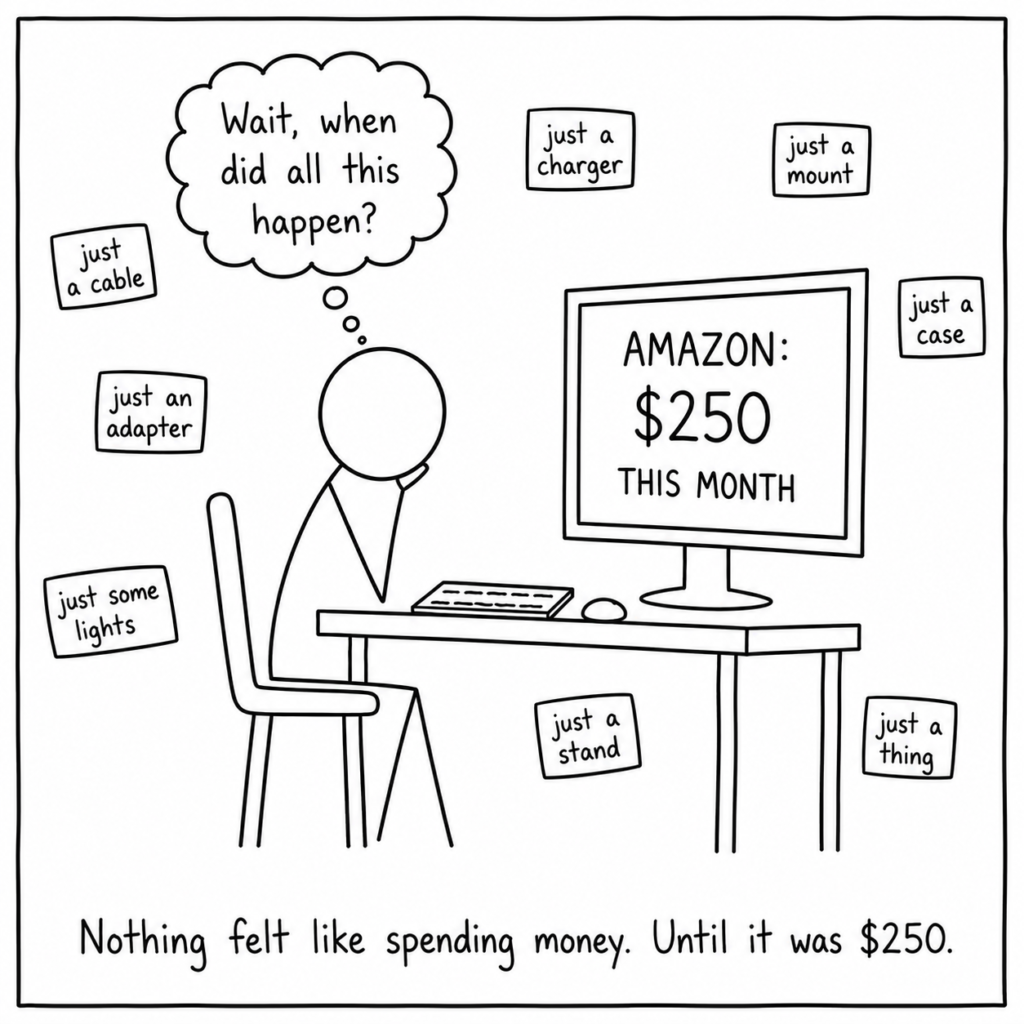
I was spending on average $250 a month on small tech from Amazon. This came as a big surprise – it always felt like I was buying a small thing at a time. An adapter for my laptop made sense – my old one wasn’t enough. The LED lights made the workspace feel cozier. The work setup made sense because I worked from home, though I kept changing the setup anyway. They were small in isolation, but I never summed them up. $47.25 phone bill, $27 subscription, $250 a month on Amazon. I hadn’t noticed any of them.
| What I tracked | What I assumed | What it actually was | What changed |
|---|---|---|---|
| Phone plan | $30/mo | $47.25/mo | Switched providers, $25/mo |
| Apple subscription | $0, thought I’d canceled it | $27/mo | Canceled |
| Amazon, small tech | Felt like nothing | $250/mo avg | Capped at $100/mo |
I started with the easiest one and canceled the $27 Apple Store subscription. That was an instant saving. I transferred my phone number to another provider. It took me some time – I didn’t want to deal with a new number, transferring every contact, and updating every account I had. That would be a nightmare. Instead, I looked for a provider that would transfer my existing number to their network. I found one at $25 a month. That easily saved me $22.25 a month.
The Amazon cuts were more complicated. I still needed it for household items. So, instead of spending $250 a month, I set a hard limit – no more than $100. I also bundled my orders so I didn’t have to pay for delivery.
But setting a hard limit wasn’t enough, some things were too tempting to pass up. Instead, I came up with two simple questions I asked myself before spending money on anything non-essential. Can I survive without it? Will it make me better, healthier, or make more money? In most cases, going through these questions would filter out impulse purchases. That alone cut $150 a month on average, just by asking two questions before pressing the buy button. I also applied the same rule outside of Amazon purchases, mostly to home improvement purchases, which didn’t make much sense while I was renting.
In total, after spending a couple of hours, I managed to save $2,391 annually. I didn’t sell anything, I didn’t invest anything, I didn’t do any stock research, I didn’t apply for a new job, I didn’t start a business. I only tracked my spending and trimmed unnecessary categories.
Knowing where the money went was the easy part. The harder part was making sure it didn’t happen again.
If you want to run the same check on your own statement, here’s the tool I wish I had.
Do it yourself
Run your own audit
Pull up your last bank statement. For each category, type what you thought you were spending, then what it actually was. Add a row for anything else you want to check.
| Category | You assumed ($) | It actually was ($) | Gap |
|---|
One article a week. Real numbers, real mistakes, no finance bro nonsense. If you made it this far, you already know if it's for you.

One Comment
Comments are closed.