Why I keep my emergency fund in a HYSA and not a checking account

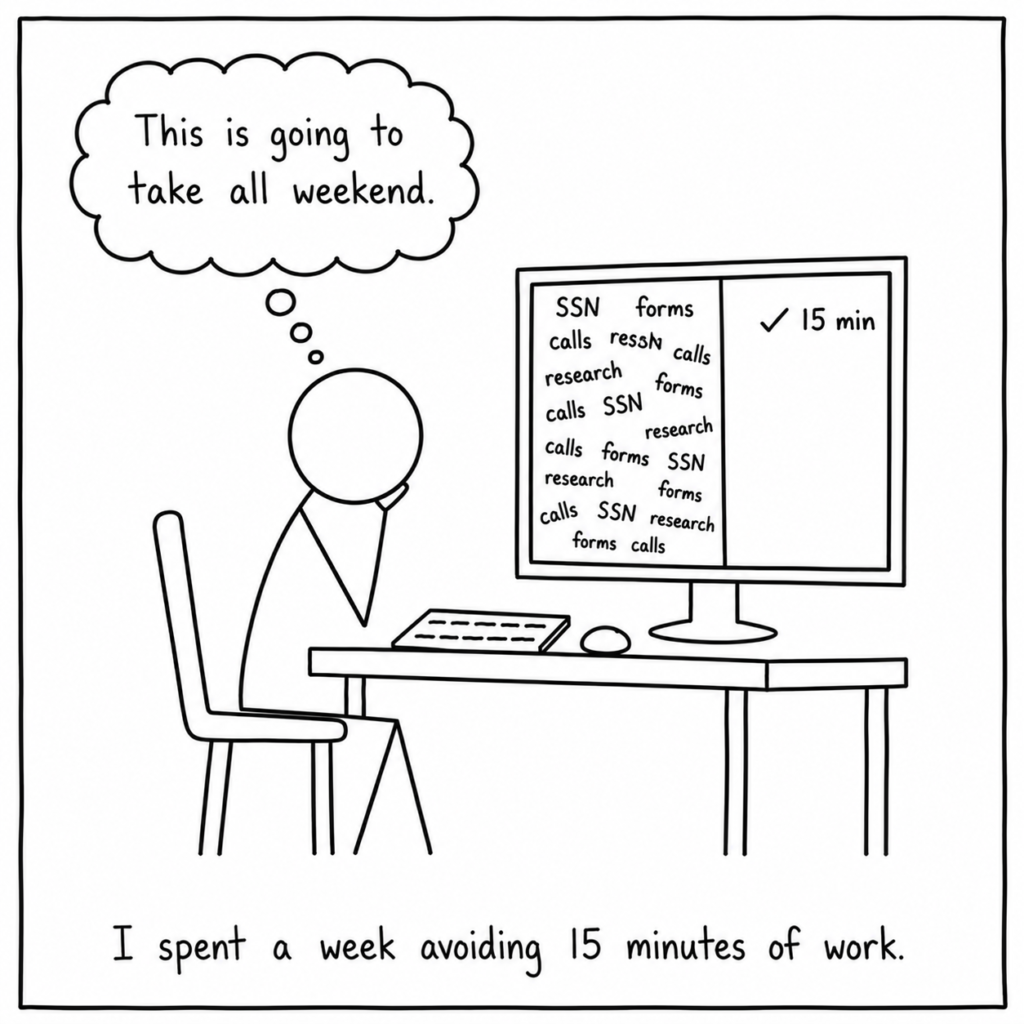
I was sitting on my balcony with a laptop, running math and thinking about emergency funds. My goal was to put my emergency fund into a high yield savings account (HYSA). I had hours blocked off in my head before I even opened a browser. In my mind, this meant researching banks first that had a HYSA, filling registration forms with my Social Security Number (SSN), email, and phone number. So my phone would ring for the next couple months with banks trying to sell me credit cards. My bank didn’t offer a HYSA, which I took as a sign this was going to be complicated. So I kept not doing it.
However, my emergency fund money was still sitting in my regular checking account. It was fine to keep one month’s worth of expenses there, but for my long-term goal of $10,000, I wanted more out of it. Otherwise the full amount would keep losing value to inflation. Eventually, the numbers won. Dealing with the process for 15 minutes outweighed doing nothing and losing money every year.
In reality, the entire research and registration process was simple. I started researching the most popular banks, their offers, rates and terms. It turned out that a typical registration process and opening a HYSA would take as little as 15 minutes, not a weekend! And I didn’t need to leave my phone number or email at every bank to get approval. I only left it once, for the one I opened.
Not every HYSA would work for me. I wanted my money to be protected, so FDIC insurance was non-negotiable (Not every bank in the US has this. FDIC insurance protects deposits if the bank itself fails or goes under. Research your local regulations if outside of the US).
Reviews were very important. I knew if something went wrong, I should have access to customer service to help me. The last thing I wanted to happen was money being stuck with no way to get help. After not checking Hashflare’s reviews before investing, trust became non-negotiable for me.
Some banks required thousands of dollars as a first deposit. I had about $2,200 sitting in my checking account as my emergency fund, but I wasn’t ready to move all of it into a bank I had never used. A HYSA was still a new concept to me, so I started with $500 instead. That’s why a low minimum deposit mattered to me.
Seeing my brokerage account grow made me feel that an emergency fund, even in a secure place, should still provide some growth. That logic made sense to me: you deposit money with a bank, the bank makes money, and you get a share of it too. I thought having some yield on emergency fund money would be great, even if it was small.
But why was it so important? Keeping six months of expenses in a checking account meant losing money to inflation every year. It was fine for me to keep that initial $2,200 in my checking account. But if I kept my long-term goal of $10,000 there instead, at 0% APY with inflation at 4%, I’d technically lose $400 a year. Next year that same $10,000 would cover $400 less of an emergency than it does today. I’d still have the same $10,000 in the account, but it would be worth less. A car repair years from now would cost more, and I’d still be sitting there with the same number in my bank account, just buying less with it. A HYSA at 1.60% annual percentage yield, or APY, would instead earn $160 a year for doing nothing, not enough to offset inflation entirely, but far better than losing $400. I wasn’t looking for the highest return here. I needed the money safe and available when I needed it, not somewhere it could lose value or take days to access. Use the calculator I built to figure out your specific case.
Once I created an account and started to transfer money, then I had to set rules for the emergency fund. What was the money really for? I had a hard rule when it came to spending it. If I lost my job, I still would be able to pay rent and bills while I looked for a new one. If my car broke down and left me in limbo, that’s what an emergency fund is for. If I had an unexpected health problem, the emergency fund would help there too, and I wouldn’t need to stress about paying for it. That was simple, and it was comforting.
Everything else outside of that category didn’t qualify for a withdrawal. No new tech gadgets, no vacation, no occasional trips, no “I’ll use it for this and rebuild next time.” If I ever needed the emergency fund money, I would start rebuilding it right away. Over time I would adjust the amount based on my monthly spending and life situation.
After setting up the HYSA and reaching the goal, I fortunately only used it a couple of times for small emergencies. I probably could have survived with much less money in my emergency fund, redistributing the extra into my investments to make even more.
The emergency fund gave me the feeling that even if I did everything wrong for the next six months, I would still be ok. And for me, that feeling was worth every dollar in that account.
Use this tool for figure out what counts as emergency and what doesn’t.
Emergency fund rule
Is this actually an emergency?
A quick reference before you dip into your emergency fund. Tap any item to see the reasoning behind it.
-
You need to cover rent and bills while you look for the next one.
-
The one you actually depend on to work or function day to day, not a backup or an extra car.
-
Unexpected, not a scheduled or elective procedure.
-
Heat, cooling, water, or safety – to the point where you can’t live or work there normally. Judge it by whether it stops you from functioning, not by whether it sounds dramatic.
-
Hurricane, flood, fire, anything that damages where you live.
-
Wanting the newest one is not an emergency.
-
Planned or spontaneous, still not an emergency.
-
Budget category, not emergency category.
-
Same as above.
-
If you’re already planning the rebuild, you already know the answer.
Frequently Asked Questions
Should I put my emergency fund in HYSA?
Yes. I keep mine in a HYSA because I can withdraw quickly, it earns far more than a checking account, and at an FDIC-insurance bank it’s also protected up to $250,000.
HYSA or money market for an emergency fund?
They’re close. Both are low-risk, and depending on the account, both can be insured. A money market might pay slightly more but might need a brokerage account. A HYSA is usually simpler to open and access. For me it came down to convenience, so I went with a HYSA.
Should I keep my emergency fund in HYSA when rates are low
Yes. Lower rates mean HYSA earns less. But the point of an emergency fund isn’t yield, it’s easy access and safety. Even at a low rate HYSA still wins over checking accounts, and access matters more than the extra fraction of a percent a money market might pay.
One article a week. Real numbers, real mistakes, no finance bro nonsense. If you made it this far, you already know if it’s for you.

2 Comments
Comments are closed.