I paid off my car loan early. Here’s what financing the car actually cost me.

I was reading news when I received a notification that the car loan balance was paid off. I definitely felt some relief, as from now on I would be saving $301 a month I had already planned for. Paying it off early felt like the end of the story. But that was actually the moment I found out what financing the car had really cost me, and it wasn’t just the monthly payment.
In October 2021, my old car repairs started to take more and more money. My main use of the car was groceries and commuting to the office, 20-30 minutes a day total. I needed a new car. I had about $6,500 allocated for this, so I could either buy an older one in cash or get a loan for a newer one. The choice was obvious to me: a newer car most likely would require far fewer repairs if I kept up with the maintenance schedule. The older car would be less money up front, but most likely require more ongoing maintenance even if I inspected it with a mechanic before purchasing.
So I ended up with a 2016 Hyundai Veloster that I put a $6,500 down payment on and financed $15,509.48 with an annual percentage rate of 6.031%, for which the finance charge was $2,485.34. Total payments were $17,994.82, and the total sale price was $24,494.82. My monthly payments ended up being $301 for 60 months.
By paying extra when I could and paying it off 4 months early, I only saved $30.78 total. It turned out, how much you save by paying off an auto loan early depends on when you do it. I found out that general auto loans are front-loaded, most of the interest gets paid off early, long before the loan balance itself is. In my case, 95% of it was already gone by year four, so paying off the last four months barely touched what was left to save. After that, this got me thinking about how much I could have saved if I hadn’t taken out a loan. What did the other $14,000-$18,000 actually buy me?
What financing the car actually cost me
Checking today, buying a Toyota Corolla or Honda Civic from 2008 in good condition would cost me $6,000-$10,000. So I might not even have needed a loan. My Veloster is worth around $8,000 at resale today. A 2008 Corolla or Civic is closer to $3,000.
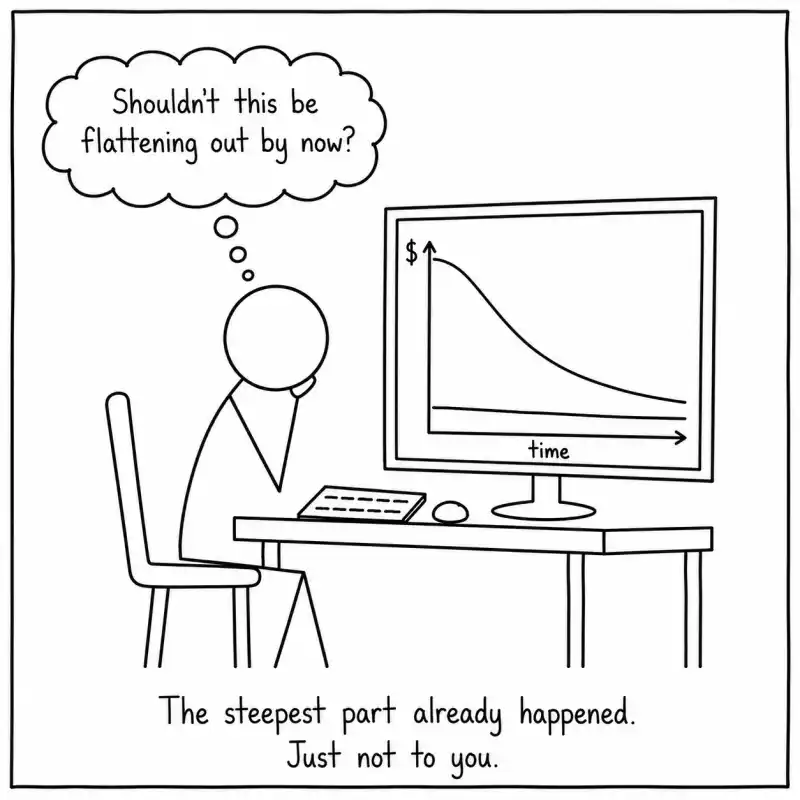
I could split those $301 monthly car payments: $200 toward investing, the rest toward a future car. My own car maintenance already takes $100 to $150 a month on this car, mostly brakes and brake pads this year. The remaining ~$200 a month I could invest for the 56 months I had the loan, call it five years. If that money followed the general market, in some years I would lose and in some I would gain. I used the calculator I built to run numbers. At 6% annual return, it would grow to $13,954: $12,000 in contributions and $1,954 in interest. At 8%, it would grow to $14,695: $12,000 in contributions and $2,695 in interest. At 10%, it would grow to $15,487: $12,000 in contributions and $3,487 in interest.
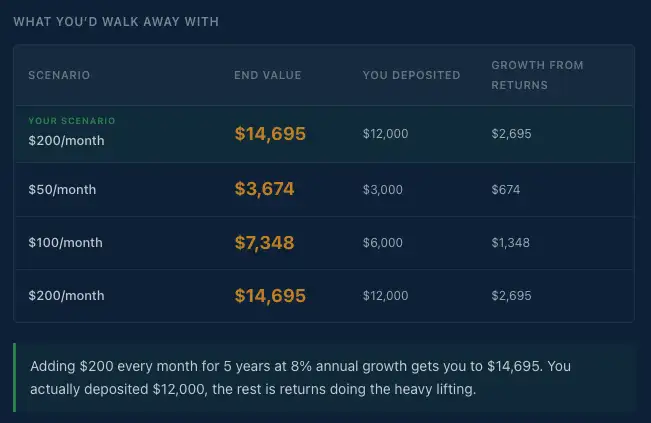
None of those numbers include comprehensive and collision insurance that I had to carry when financing a car. Not having that coverage could also save $38 a month. Instead of spending $24,494.82 and ending up with a car worth maybe $8,000 in 5 years, I could have chosen another route and ended up with a car worth $3,000 and $13,954-$15,487 in my account.
The cost for me wasn’t interest only: it was car depreciation in price (~$16,500), cost of credit ($2,485.34), insurance ($38) and the growth I lost by not investing that money.
That was the cost of not asking the question, and not thinking it through, before buying a car.
Simply because I didn’t know how to think about it. Unlike the road trip, planned in advance and adjusted after the fact. This one, I never planned at all. The tool I built helps answer this question.
The real cost of the money
The alternative you didn’t price out
Why now
Fill in what it costs above to see the real picture.
One article a week. Real numbers, real mistakes, no finance bro nonsense. If you made it this far, you already know if it’s for you.
