I invested in Nvidia. I was right for the wrong reason.

June 2020. I bought 0.131759 Nvidia shares for $50, at $379.48 each.
It’s been 17 days since my first investment purchase, Antero Midstream. I still hadn’t seen the result of my first investment, but I couldn’t wait to prove my research and selection process worked. I had another $50 ready for my next purchase, with $50 more expected the following week. So instead of adding to my initial position, I decided to cast a wider net and research fields outside resources and energy.
At first, I started to google what other economic sectors I could participate in. The Federal Reserve interest rate was around 0.25%, which I thought would make credit more available not only to companies but also to consumers. However, I couldn’t really find the reason why the financial sector would grow significantly. I saw online posts about people describing their investments in Bank of America, but I simply couldn’t understand the reason behind it. To me, banks were always providing credit. And with lower interest rates, banks would provide more credit, but it wouldn’t significantly increase their revenue and stock price. So I passed on it.
I thought about the healthcare sector and Pfizer, especially demand for post-Covid-19 vaccines and medications. But to me, healthcare wasn’t one thing. Insurance companies, research companies, manufacturers, healthcare providers – they would all have different reasons to grow. I didn’t even know how to apply my research process or where to start. Even with Pfizer, people would only need a vaccine once or twice, and not everyone would need one at all. That didn’t look scalable to me, meaning it couldn’t grow big without hitting a natural ceiling. How would I scale vaccines? I decided to pass on this one for now too.
I also passed on food and goods companies such as Walmart. Companies selling grocery and household goods – why would they suddenly increase in revenue? For that to happen, people would need to buy more, eat more, move in or buy houses. But how much more could people realistically eat or buy? People couldn’t just start buying 50% more food if they didn’t need it; it would expire. I thought even with cheaper credit from banks, that still wouldn’t automatically translate into increased food and goods revenue. The population also wouldn’t suddenly increase to trigger more demand. On the other hand, food was probably the last category people would cut back on. I figured food and goods would at least hold during an economic downturn, since their revenue would suffer the least. However, this wasn’t what I needed. I needed growth.
Another sector I was researching was remote-related communication and work software, such as Zoom. Many companies announced remote-first policies after the pandemic. To work remotely, they would still need to communicate, schedule meetings and events, and track projects. They would need to buy or subscribe to software and pay for it. That meant some business would get paid, which meant revenue would increase by a big margin from new clients. However, I had no reference to judge how long it would last – there was no such event in the past. So I couldn’t build a real scale estimate of how far it could go. I decided to pass on that as well.
My next sector was computers and hardware
My next sector was one of my own interests – computers and hardware. I always liked building custom PCs, finding components online, comparing deals, and comparing performance. Virtual Reality and Augmented Reality always seemed to me like a clear future. Surgeons practicing on realistic simulators before touching a real patient – the more realistic it looked and worked, the heavier the rendering would be. Pilots seemed like the same idea to me: a flight simulator is only useful if it’s detailed enough to actually prepare someone for something going wrong. Anything trying to model something physically massive – buildings, spacecraft, planetary data, large 3D environments – went into the same bucket, as far as I could tell. Math-heavy predictions, cryptocurrency mining, gaming – different fields, but the same bottleneck for me, just on a smaller scale.
And none of this felt niche to me. If humanity kept expanding into any of it – deeper simulation, deeper space, deeper modeling – this would need to be resolved first. It was clear to me. And the market seemed huge; most of the other sectors could benefit: healthcare, military, consumer gaming, even resource planning and mining. I could clearly see the long-term pattern, and to me the entire market didn’t seem to understand it. So this sector, compared to those I had researched before, was clearly much more scalable.
To me, the entire market didn’t seem to understand it.
I started my research and followed the same pattern I used when researching Antero Midstream. I knew and had experience with the three biggest players on the market: Intel, AMD, and Nvidia.
Intel’s processor innovation had stagnated for almost a decade, showing little to no performance improvement year after year. It was obvious to me – mostly because AMD had years of failures, Intel had no real pressure to innovate. But with AMD’s new Zen architecture, Intel’s business seemed to struggle more. And to me, Intel was absolutely not competitive with Nvidia’s graphics cards business. This way, Intel was out of consideration for me.
AMD showed great progress after years of decline. But it was clear to me that AMD’s graphic cards were losing in most of the benchmarks to Nvidia when it came to video and photo rendering. I concluded that AMD would focus on taking a bigger market share from Intel, who couldn’t satisfy consumers’ needs for a couple of years, rather than try to overtake Nvidia’s dominance in graphic cards. Nvidia was also the company that benefited the most from recent cryptocurrency mining as miners were buying their graphic cards in bulk, which directly increased their revenue.
Market capitalization,basically how much the company is worth, also looked small compared to its potential, around $220 billion. Compared to Apple at $2 trillion, it was quite a small market cap with a lot of room to grow. The key was: if Nvidia could diversify and increase its revenue, together with growing demand, I thought the market capitalization could eventually hit $400B-$700B. More business and corporate customers would directly support that.
I finished my research with the belief that Nvidia could hit that milestone in the long term – about 4-6 years for me. So I started to invest $50 every couple of weeks until the end of the year.
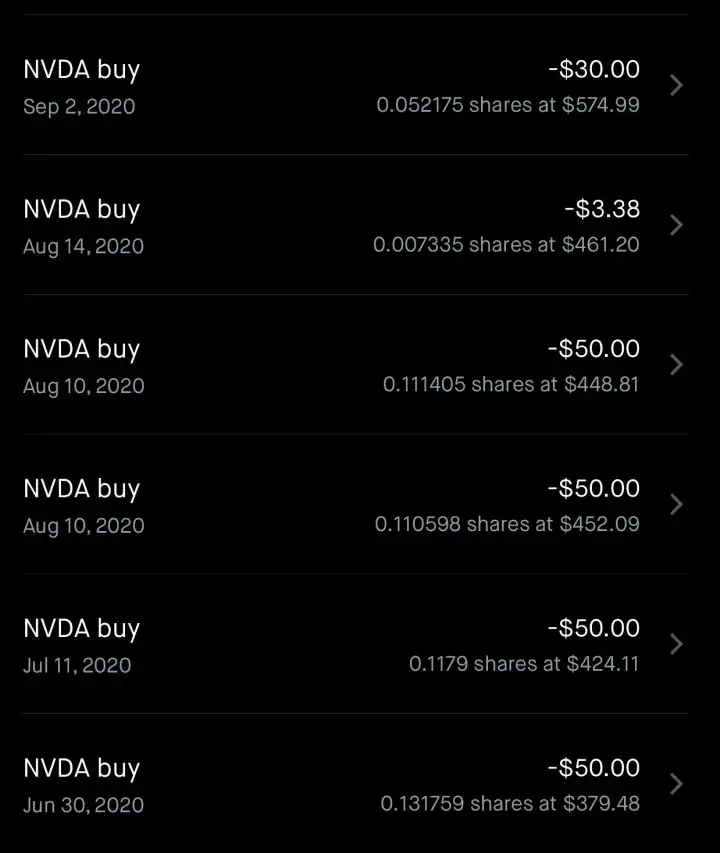
Time went on, and by the end of 2020 into early 2021, I noticed my portfolio was growing thanks to Antero Midstream’s dividends and growth. Nvidia was up 23% since July – six months. To me, it looked like my pattern clearly worked, even sooner than I expected. It proved that my research, done for the long term, was starting to play out. It was clear I didn’t need to reevaluate the process. I just doubled my investment amount.
Over the next two years, I kept increasing my investments. In 2022, when the market was down, I increased my contributions further. I believed the market would eventually recover – I just didn’t know how fast and by how much.
Then ChatGPT happened
Then late 2022 came. I started using ChatGPT at work and for side projects. I was naturally curious about what hardware leading companies were using to train and run these models, to later make the final product available to millions of people. That would be massive revenue for someone. It turned out to be tens of thousands of the most advanced Nvidia cards. I googled it – over $10,000 each. Someone paid Nvidia real money to buy them. That meant Nvidia’s revenue increased. Tens of millions of dollars just to run it, but if companies needed to scale, they would need to buy more – and more powerful ones.
Two months later, people were talking about these tools everywhere online. People were using them. More new companies started training models and building chatbots, and more tools that directly used these models became available. It was clear that all these small and big companies needed graphic cards to train and run the models behind these chatbots. They were paying someone.
I kept investing as I saw my investments growing. But I was absolutely wrong about why the company’s revenue was growing. It was almost confusing – I did research that was convincing, but the actual result, still positive as I had planned, had nothing to do with my original reasoning. I didn’t know if I could trust the reasoning. Was I right by luck, or was I right by process?
It was almost confusing – I did research that was convincing, but the actual result, still positive as I had planned, had nothing to do with my original reasoning.
One article a week. Real numbers, real mistakes, no finance bro nonsense. If you made it this far, you already know if it’s for you.

2 Comments
Comments are closed.