My portfolio was down 17% in 2022. I invested $4,850 anyway.

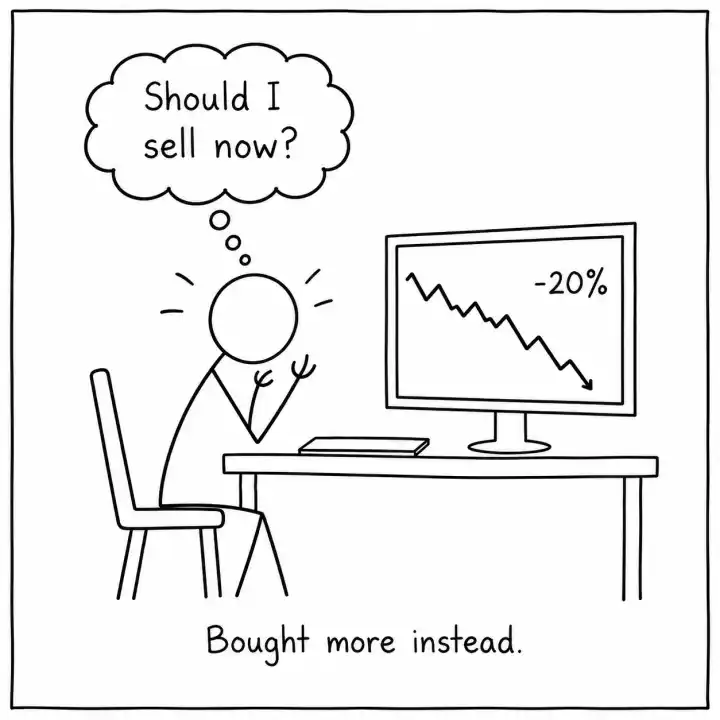
September 2022. I was looking at my brokerage account, and almost all companies I invested in were marked red. The market was already down 17% from the beginning of the year. I continued investing and even increased the amount.
For the whole year I saw my portfolio go lower and lower, crossing double negative digits. My biggest investments in the brokerage account were Nvidia and Cheniere Energy, with the rest having less attention than these two.
The first time seeing a negative portfolio return in the middle of the year made me think the research process I had for 2 years, and the strategy I used, only worked because of luck, not because my process was good, until I noticed I wasn’t alone. It wasn’t specific to only the stocks I held, it was a market-wide trend, and I was tracking closely with market-wide performance. That made me realize if the whole market went down, sooner or later it would recover. I remembered the market going down during the COVID-19 pandemic in early 2020, then recovering and continuing to grow, but I couldn’t participate back then.
Why I kept buying when my portfolio was down 17%
That made me realize that holding instead of selling might be a great idea. If I sold, I would be negative, and given my long-term plan, I would reinvest later, once the market recovered. That just made no sense. I would take all the damage from the loss but wouldn’t benefit at all from the recovery, since I wouldn’t be able to predict the exact day my stocks would go back up. Nobody could predict that. I was thinking about this for the whole evening, even at the gym, still wondering how I would know if today was a good time to buy, or how long that downturn would last. Was it even possible to approximate, or use past market downturns to get an idea?
I would take all the damage from the loss but wouldn’t benefit at all from the recovery.
I walked with this idea for the rest of the evening until I realized I didn’t need to know the exact date, week, or even month. I could treat the entire market downturn as an opportunity to buy, since prices would be lower than they were before.
My initial idea of long-term investing was 2 years. However, if the company was doing great, why would I sell? I figured all I needed to do was make sure that my original research and drivers were still valid or improved. If they improved or stayed the same, that meant once the market recovered, those companies would benefit the most, as they would continue to grow post-recovery.
The only adjustment I needed to make was to extend my definition of “long-term” to a couple more years. That meant verifying companies’ financials, margins, and competitors. Specifically for Nvidia, I checked that the reasons I found in 2020 were still valid: demand for graphics accelerators, that Nvidia was still leading over AMD and Intel, and that revenue was still growing. For Cheniere Energy, I checked whether the scale-to-margin assumption from my original research was still correct, since exports kept growing.
For the market to recover from a 17% loss, it would need to rise 20% to get back to where it was (1 divided by 0.83). That meant every dollar I put into the market would be up 20% if the market only returned to where it was at the beginning of the year. All the negative numbers in my portfolio weren’t real losses until I sold them.
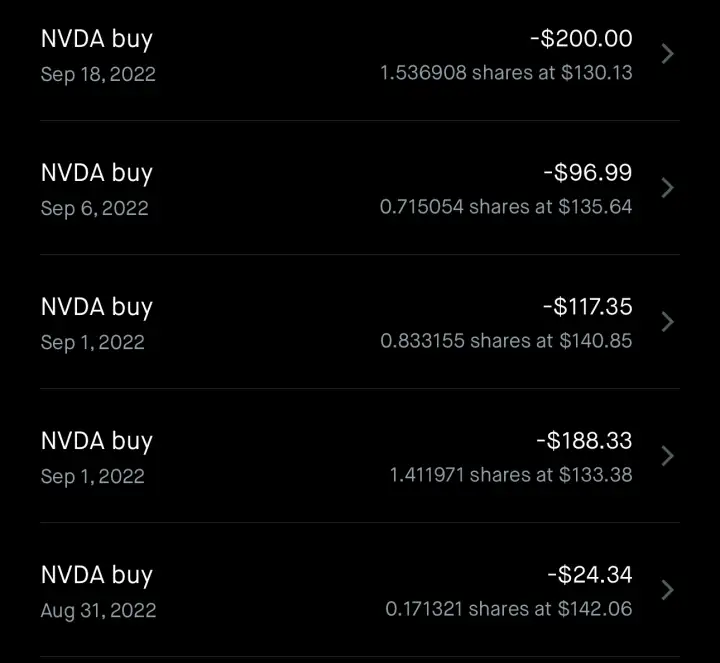
I started transferring more into my brokerage. Most of it went into Nvidia that month, five separate orders across 19 days: $24, $188, $117, $97, and $200.
I more than tripled my monthly investments into my brokerage, investing a total of $4,850 in 2022 vs $1,480 in 2021, and even more than 2023’s $2,160 in a rising market.
Holding and buying while the market underperformed turned out to be a good decision. But in the moment of doubt, how did I tell the difference between grounded conviction and just blind refusal to admit I might be wrong? I didn’t know, not until later.
One article a week. Real numbers, real mistakes, no finance bro nonsense. If you made it this far, you already know if it’s for you.
