Should I invest in international stocks? I held mine in one Chinese company

April 2026. I sold all my shares of Alibaba (BABA). It was 15.65% of my brokerage, the only stock I had bought for international exposure, and it was up 44.75%. I moved most of the money into an emerging markets ETF that still holds Chinese stocks.
I had been buying it since October 2021. The idea was simple. Alibaba’s business covered multiple fields: marketplaces for businesses and for shoppers, and cloud computing. In 2023 the idea got stronger with its artificial intelligence research and its own AI models. Such a giant should have been worth much more than it was. If it had been an American company, it would have been worth several times its market capitalization.
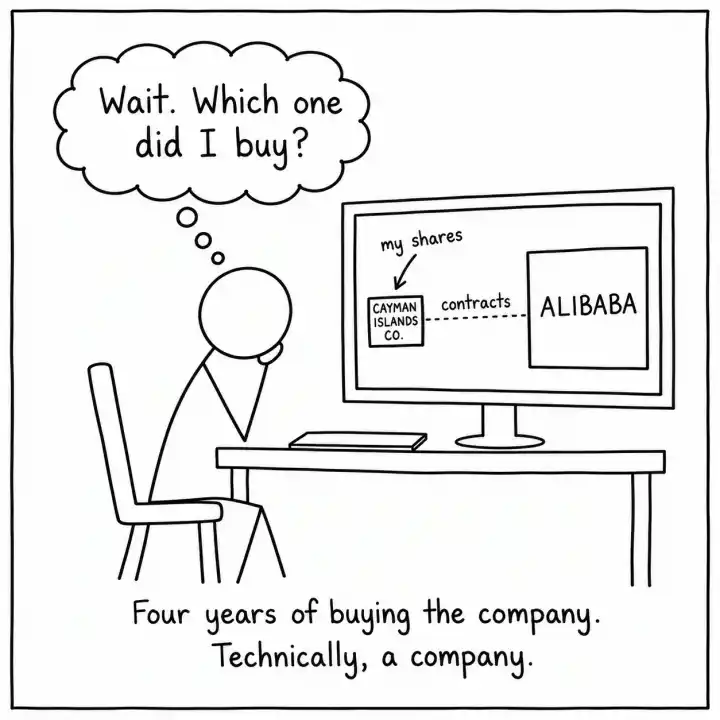
What I actually owned when I bought Alibaba stock
In 2025, after almost 4 years of buying and holding Alibaba, I got curious why such a giant company with decent revenue growth was valued so much lower than its American competitors. Most of the articles, blogs and posts I found were about the political risk of owning Chinese companies, strict local regulations and something called VIE. The last one was new to me. VIE was short for variable interest entity. Chinese law didn’t let foreigners own internet businesses like Alibaba’s. So Alibaba listed abroad through a Cayman Islands company that controlled the Chinese businesses through contracts, not ownership. That Cayman company was what I had been buying since 2021. If Beijing ever decided those contracts didn’t count, my shares could be worth very little, while Alibaba itself would keep running.
My shares could be worth very little, while Alibaba itself would keep running.
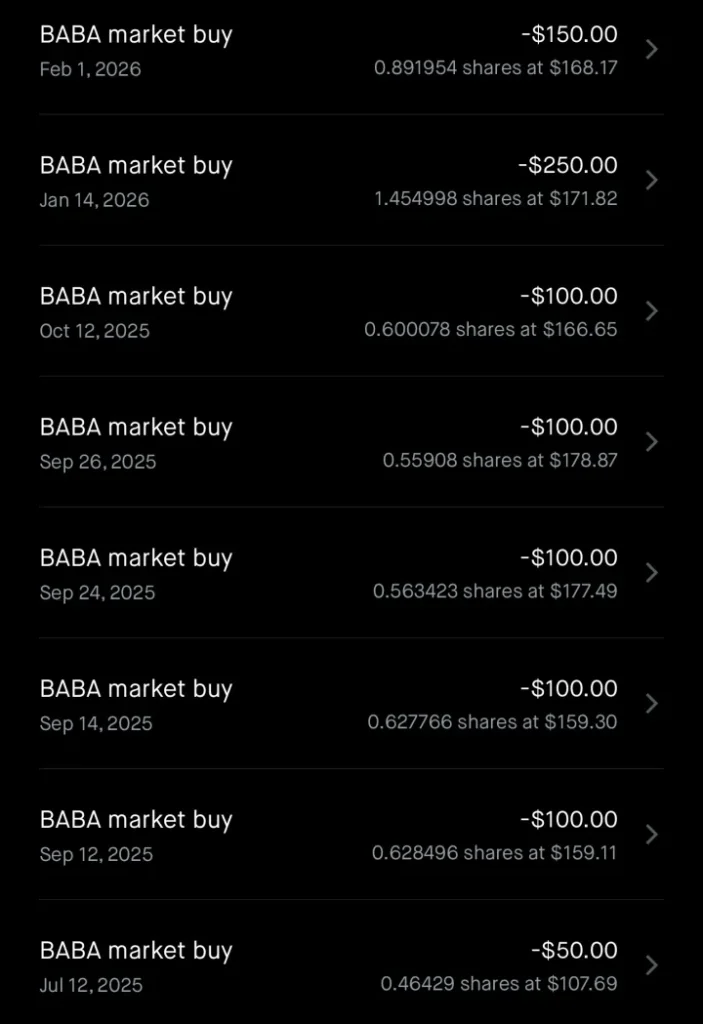
For the rest of the evening I was thinking: should I sell it? What were the chances of a political situation hurting Alibaba stock? How much AI-driven revenue growth would it take to outweigh the risks? To me, the chance of political tension serious enough to take my shares to zero seemed very low. My main thought was that China was so deeply tied into the world economy that any escalation would be handled carefully. It also helped that 2025 was a good year for Alibaba stock, mostly thanks to positive AI news and Qwen, Alibaba’s own AI model, getting more and more popular. I decided to keep investing until the next earnings report and then see how the stock and the company were doing. So I kept buying, adding $1,100 over the next 8 months. $900 of that went in at $159 to $179, and I sold it all in April at $124. Most of my money, though, had gone in years earlier at $70 to $85.
Is it safe to hold international stocks in one company?
I didn’t want to keep all my eggs in one basket again, the way I had with Alibaba, where most of my international money sat in one company that could go to near zero, however unlikely. I didn’t like having money in a single company on the other side of the world, in a market I didn’t know. Even reading the news, it was hard to keep up with local regulations. On top of that, I had to follow politics, government decisions, and export and import rules. It took far more time and effort than I had. With US companies, or fields I knew, I understood the rules and the demand. There, I could have an edge. For international stocks, a fund that followed an index could do the tracking for me, and my time could go to what I could actually follow.
Why I kept China in my emerging markets ETF
By the end of 2025 I had already added a fund of mostly developed markets to my Roth IRA, meaning rich, established economies like Japan, Germany and Canada. What I barely had were emerging markets, countries still growing into big economies, like India, Taiwan or Brazil. Even though I was planning to move away from Alibaba because of political uncertainty, I didn’t think it was wise to ignore a market as big as China. I looked at emerging markets ETFs ex China, funds that leave China out completely. I didn’t like that idea, because I still wanted some money in China, just not in a single company. An emerging markets ETF with China in it sounded much better to me. Even if the unlikely scenario happened, I would still have holdings in other emerging markets to soften the loss.
So I started researching. I wanted exposure to South Korea, Taiwan, China and India. It turned out AVEM, an emerging markets ETF from Avantis, held all four, along with other emerging economies. China was just under a fifth of the fund, and Alibaba was less than 1%.
15.65% in one stock, now one fund of thousands
In April I decided to rebalance my portfolio, bringing each holding back to the percentage I had planned. I sold all my Alibaba shares, up 44.75%, and moved most of the money into AVEM. The rest went toward rebalancing my other investments. My exposure to China went from 15.65% of my brokerage, all in one company, to about 2%, inside a fund that holds thousands of companies. As of October 2026, AVEM is up about 9% since the move, and Alibaba is down about 10%.
I learned about VIE in mid-2025 and still added $1,100 over the next 8 months. What changed my mind wasn’t new information. It was looking at my whole portfolio at once. Which makes me wonder what else I’m holding right now that I already know is risky.
These are the three questions I should have asked myself in July.
One stock, three questions
Three things I never checked when I bought Alibaba. It took me eight months to ask.
0 of 3 answered
What do I actually own?
Why this matters
Some foreign companies sell US shares through a holding company set up abroad. With Alibaba, US shareholders own a Cayman Islands company that controls the Chinese business through contracts, not ownership. The annual report says so in the first pages (foreign companies file it as a Form 20-F). Search it for “VIE”.
VIE stands for variable interest entity. It means you own a shell company, and the shell has contracts with the real business.
Can I follow what could hurt it?
Why this matters
The rules it has to follow, the politics around it, and news I can actually read. For a US company in a field I know, usually yes. For a company on the other side of the world, often not.
How much of my money is in this stock?
Example numbers are my real split from early 2026, scaled to $10,000 for privacy. Your numbers never leave this page.
Is there a fund that holds this company?
Why this matters
Big companies are usually inside broad index funds. A fund’s top holdings list tells you if it’s there. I moved my Alibaba money into an emerging markets fund where Alibaba is under 1%.
Things worth checking
One article a week. Real numbers, real mistakes, no finance bro nonsense. If you made it this far, you already know if it’s for you.
