How I plan a road trip budget that matches what I actually spend

I needed to start planning a road trip that I put in my calendar a long time ago. What crossed my mind, places to stop, hotels, food, rental or driving my own. That would be a whole evening of research.
I had a framework I refined over a few trips. It involved deciding on dates and places, figuring transportation, rate-checking lodging without booking early, allocating for food and miscellaneous spending, and funding it in advance. But how exactly did I budget for that?
I found it useful to plan with the full list of destinations and then build everything on top of that. This time, it was Arizona to Yosemite National Park. I quickly opened Google Maps and mapped a rough route, around 1,600 miles. To make this trip, we would need 7 days, so the route was made. The route was set from Arizona to California, north to Yosemite, and back through Death Valley. I figured we would drive no more than 4-5 hours a day. We would need to stop at San Clemente, north of Los Angeles, Yosemite, somewhere on the road to Death Valley and on the way back to Arizona. That gave the list of stops.
It became clear we would need a car with higher clearance to drive there. So we went with an SUV. Rental won over driving my car. Mostly because of the ground clearance and peace of mind. If anything broke, it wouldn’t be my own car on the hook for repairs.
We found an online coupon for one of the biggest rental agencies so the total rent with all fees and additional drivers came to $514.15. That was a tradeoff for peace of mind during and after the trip. The gas mileage would be between 26 and 33 mpg. I took an average of 29 mpg and $4.80 a gallon, and rough estimations came to 1,600 miles / 29 mpg x 4.8/gallon = $264.83. I put $250 into the budget as we would drive in Nevada and Arizona, where gas would be significantly cheaper than in California.
The lodging was a big category. I never liked the idea of booking something a week or even a couple days in advance when doing a road trip. Maximum 1 day before, no earlier. Simply because for me the entire idea of road trips was an adventure, which meant keeping the freedom to be late or skip a stop.
We had a route, but we haven’t visited those places yet. Why commit earlier?
Looking at online websites, I estimated an average to be $150-$170 per night for 2 people.
Given that same-day availability wasn’t guaranteed, I bumped the average to $180. So $180 x 6 nights = $1,080, to which I added $20 for an error and budget math simplicity. So I put $1,100 into the lodging budget for 6 nights. Booking in advance would probably save us $100-$200 in total. However, flexibility and being able to change our next stop based on pace were important, so I accepted this price-flexibility tradeoff.
The main goal of this entire road trip was hiking in the mountains for a couple of days, so I allocated $80 towards annual park pass renewal.
I always estimated $50-$75 per person for food. For the two of us, given that the hotels I looked at usually had breakfast included, I used the lower end of that range and put $50 x 2 people x 7 days = $700 into the food category. For souvenirs, I allocated $100 as I would buy some magnets and gifts for my friends. Usually I don’t spend that much, but a long list of destinations pushed me to allocate more this time. For miscellaneous spending, I expected exactly $0 but allocated $75 as a buffer, for anything I forgot at home or a small emergency.
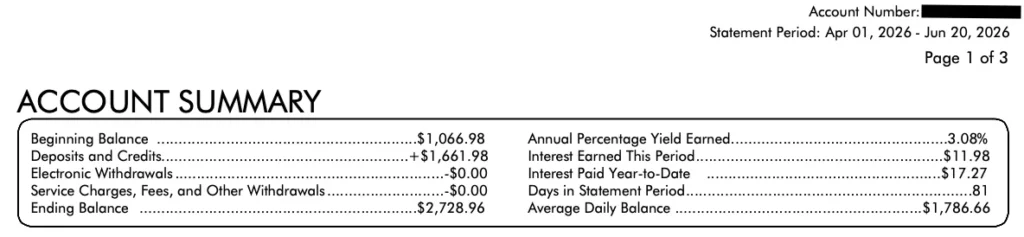
So the total budget for a 7-day road trip for the two of us was set to be $2,819.15. But where did this money come from? At the beginning of the year, once I set the date in my calendar, I started to transfer $400 monthly to my HYSA, which I have specifically for vacation. It took me 7 months to reach $2,800. The HYSA earned the same APY and had the same rules as the one I use for the emergency fund, but that money stayed separate, so it wouldn’t confuse me when I do budgeting. So I would never end up using the emergency fund to cover the vacation. That money wasn’t for this. In total between the seven months of contributions and the extra month before the trip, the account earned around $22 in interest. By the day the trip started, everything was already funded and planned.
The trip was great. We visited many places, hiked under the rain, and experienced 120°F in Death Valley. But what made the trip really nice and relaxed was the planned budget and preallocated money. Once I came back home, I started to reconcile all transactions from the road trip. Food, souvenirs, and miscellaneous items came in under budget, with no real surprises. Gas was the exception. $7-a-gallon gas stations in the mountains pushed it $87 over. Lodging came $143.64 over budget because of the same-day bookings.
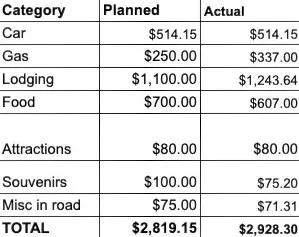
In the end, we exceeded the budget by $109.15. That came from a regular checking account, the only withdrawal we made. What mattered more was that I didn’t have to change my short- or long-term goals. Unlike the car repair, which changed how I think about money, I didn’t have to change my habit of investing at all because of an in-advance prepared budget.
On my earlier trips, I used to believe budgeting was what limited the enjoyment and left a bitter-sweet feeling that lasted after the trip. In-advance planning and budgeting changed the way I looked at it. The money question was answered long before the trip even started.
One article a week. Real numbers, real mistakes, no finance bro nonsense. If you made it this far, you already know if it’s for you.
