I added one column to my spreadsheet and my budget finally made sense

I was going through my annual spending and budget review in late December. I already had a budget in place for the last year and an emergency fund built. I went through every category, comparing what I had spent against what I wanted to allocate going forward.
At first, I built a simple spreadsheet with just two columns: category and actual budget number. Although this format made it easy to track my monthly spending, it failed to capture when I had finished paying something off. I didn’t realize this was a problem until one month I noticed my bank account had more money that it should. I double checked and it turned out to be course fees I had been paying monthly installments. They were done. Almost $500 a month, sitting in my bank account, unallocated. I hadn’t accounted for it because I only tracked what was happening now, not what was about to change. I’ve seen people building spreadsheets with 40 categories, multiple pages, different colors. Even people buying separate journals, colorful pens, bookmarks. That lasted a month. I needed something useful and simple.
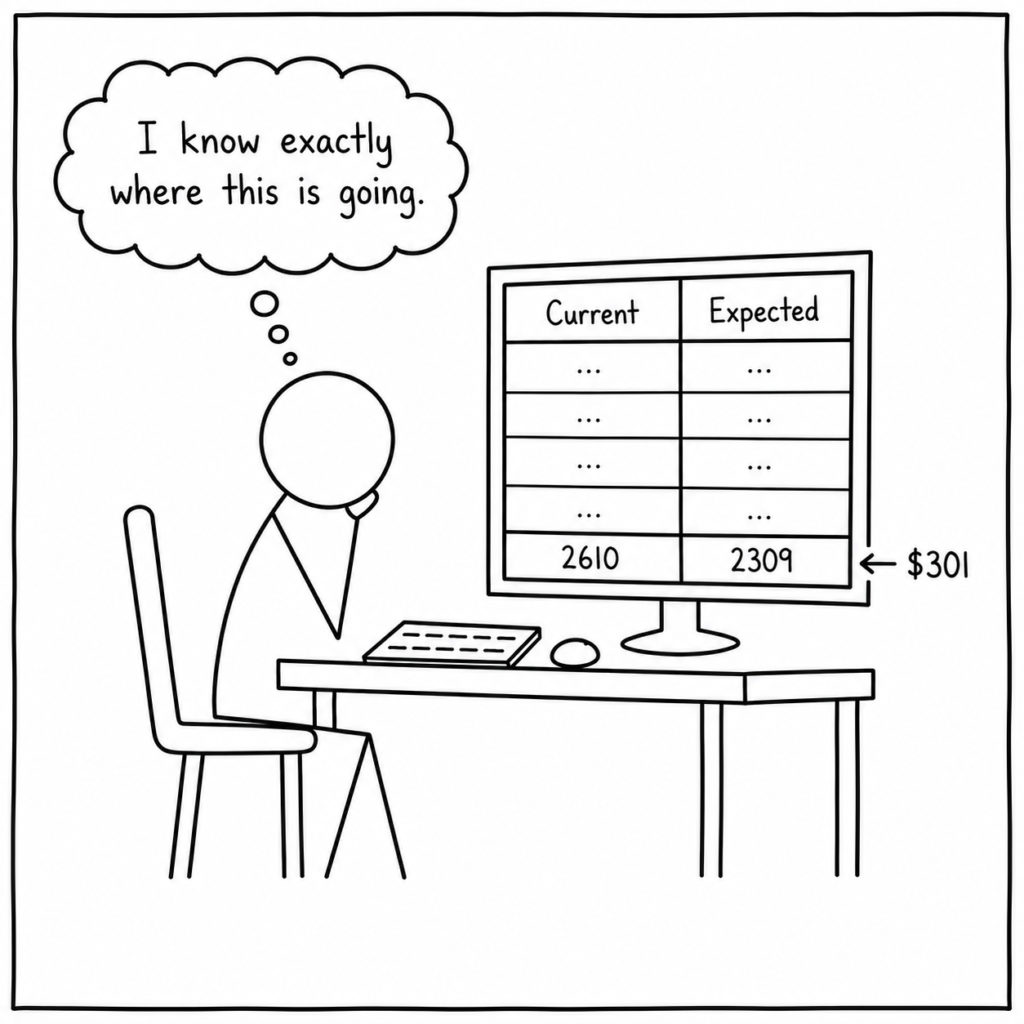
In response, I made a simple adjustment. This time I used two budget columns and labeled them “Current” and “Expected”. One reason was my car loan, which I expected to pay off by mid-year, freeing up $301 a month. I needed to allocate that money in advance so I reserved it for investing instead of letting it sit somewhere and get spent as “available money”. Tracking current and expected spending together helped me account for changes before they happened.
So, I drew a table with current and expected columns and listed all categories such as rent, groceries, gas, car loan. The projected column mattered to me as I could see how big future changes would be compared to my total spending. This way I reviewed my spending, made an approximation of what would change in the near future, and put those numbers into the “Expected” column. Specifically, I put $301 for my car loan into the current column and $0 for expected. I could see how big a slice of the pie it was before accounting for any changes. That gave me the exact number so I wouldn’t end up with “This would cost approximately $200 a month” when the real number would be much higher. By this point my spending had grown, I was investing more in learning, courses, and health checkups that weren’t part of my budget a year earlier.
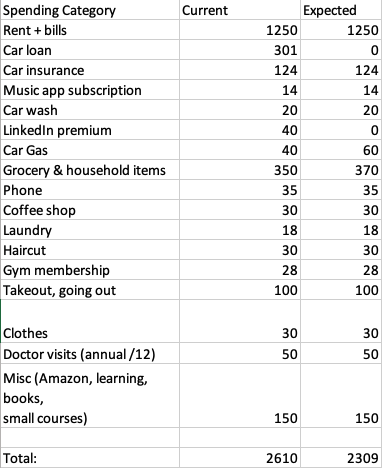
I also found it useful to divide my expenses into two categories: fixed vs variable. It helped to see where money was most likely to leak. Because no matter what I did – fixed spending couldn’t save me money, but variable categories could accumulate quickly, even without a single large transaction. I put the loan and rent into a fixed category since those were mostly fixed for the whole year, unless I moved or managed the loan in a different way, which I didn’t. There was also no way to suddenly increase or decrease them month by month. On the other hand, I had some short-term courses, subscriptions, and takeouts, which could easily go out of control as the numbers were small and it was always “another $10 for this”. Read the full story here. I marked those as variable which I would keep an eye on as they could quietly go out of control.
No matter what I did – fixed spending couldn’t save me money, but variable categories could accumulate quickly, even without a single large transaction.
The 12-month budget stopped working for me as I started to have more financial changes throughout the year. I needed a shorter cadence. After some trial I noticed a 6-month review worked best for me. That way I didn’t have to spend much time constantly reviewing the same numbers every month, but I also didn’t lose control over my budget with annual reviews. I also set rules to adjust the budget in case of sudden changes. However, it turned out I didn’t have to review it very often as I already accounted for the changes in the “Expected” column.
I went through the same process of reviewing my spending and setting a budget for each of the categories. If I got extra money due to increased income, side hustles, or expected changes, I could already start accounting or researching where to allocate it most efficiently. If my income went down, I reviewed the budget once again to look for where I could cut, and if I needed more to cover essentials, that is where my emergency fund helped.
After the December review, every change that was coming already had a place to go.
Your budget
| Spending Type | Current | Expected | Remove |
|---|---|---|---|
Fill in your numbers to see your monthly change.
One article a week. Real numbers, real mistakes, no finance bro nonsense. If you made it this far, you already know if it's for you.

One Comment
Comments are closed.