Why I don’t buy individual stocks in my Roth IRA

I was keeping up with news from the sectors I had stocks in: energy, resources, technology and hardware. I also checked my two retirement accounts, 401(k) and Roth IRA, just to see the balance and performance. But I didn’t read earnings reports or news for anything there, because there was no single company to track. So I had my Nvidia, and other stocks I was researching, sitting in my brokerage account.
But I couldn’t keep up with researching every sector of the economy on my own. I didn’t have that much time, and more importantly, the knowledge. I knew about funds for a couple of years by then, but never liked the idea of investing in them, until now.
The difference between owning a company and owning a bucket of them
A stock was a small ownership in one company. Depending on the type, it could come with a vote at shareholder meetings and, if the company paid dividends, a set dollar amount per share in dividends. But funds were different by structure. I already knew from my previous research that an ETF (Exchange-Traded Fund) was basically a bucket of many stocks, often separated by economic sector, country, or a set of countries, and traded during the day. Mutual funds were similar: also buckets of many stocks, but priced and traded once at the end of the day. What mattered more to me was that they usually had capital gain distributions, which meant I could have zero sales during the year and still owe taxable distributions. I found this out in my second year of investing, preparing documents for tax filing, when I was asked about capital gains and losses. A capital gain was a profit I got when I sold an investment for more than I paid for it. A capital loss was the opposite, selling for less than I paid.
But it only became real once I sold, not while I was just holding and watching the price move.
Two evenings for a stock, no process at all for a fund
Funds seemed to have lower returns than the individual companies I was investing in, at least for the couple of years I had been at this. But individual stock research was taking real time, and what I was reading, books, articles, and my own digging, suggested that even professionals whose whole job was researching stocks didn’t reliably outperform simple funds over the long-term. That made me rethink my assumption that funds were a secondary, almost optional part of investing. It turned out they were a real strategy on their own, even without any individual stocks added. To me that meant I didn’t need a strong opinion about every sector of the market. Funds could hold what I hadn’t researched, while I put my time into the stocks I was actually researching. And one bad day in a sector couldn’t destroy the whole portfolio. I didn’t have to research every industry just to protect against that. My individual stocks were added on top, in the areas I was willing to do the work.
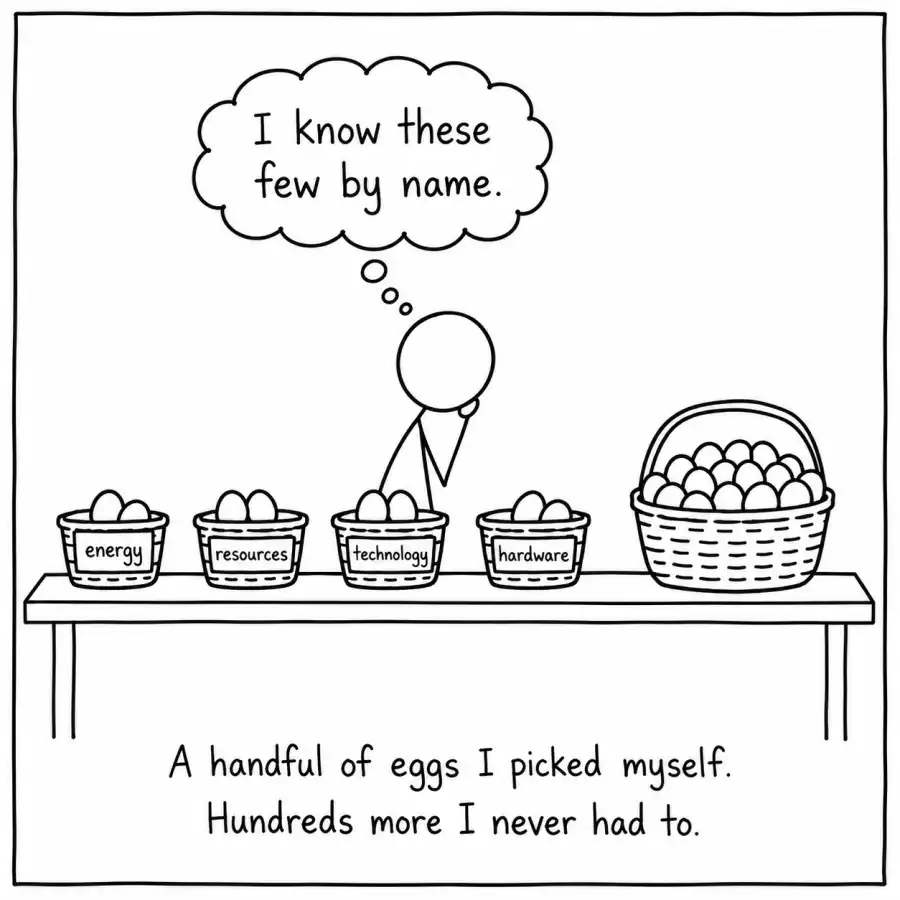
That’s how I thought about it: funds for what I hadn’t researched, stocks for what I had. In practice, I had 3 accounts: the 401(k), limited to a handful of preset options; the Roth IRA, which held one fund; and the brokerage, where I was doing individual research and picking companies myself.
Mutual funds fit tax-advantaged accounts well. I did some quick math and realized they’d be great for the Roth IRA, since I wouldn’t owe tax on the profits they distributed. Keeping them in a brokerage account would mean paying tax every year on gains I never chose to realize, and as the mutual fund portion of my portfolio grew, those distributions would only get bigger. If I didn’t have cash on hand to cover that, and no losses elsewhere to offset it, I could end up selling part of my own investment just to pay tax I hadn’t planned for.
Back in 2020, researching a stock for me meant two evenings reading about the company, industry news, demand trends, potential tax benefits. That was enough for me to buy. Then in 2022, when I opened the 401(k), I just split money across whatever options I had. No real reasoning behind it. By 2024, when I opened the Roth IRA, that changed. I wanted whole-market exposure to protect myself, and I knew fund selection deserved more time than I had right then, so I held off instead of guessing. Even putting $700 a month into the 401(k) and $80 a month into the Roth IRA, my process there was still incomplete, nowhere near the two evenings that made me comfortable enough to buy a stock. If you want to see what an allocation might look like, the Bogleheads three-fund portfolio is one example people use.
I could buy individual stocks in my Roth IRA. I don’t
I was reading that keeping high-conviction individual stocks in a Roth IRA would be a smart move, mostly for the tax-free growth. I didn’t do it this way.
The first disadvantage I knew it had over the brokerage for this case was that it didn’t allow deducting any losses at all. My brokerage account let me use a loss to offset other gains, or even lower what I owed overall. Going to zero for a fund was a very unrealistic event to me, but even a well-researched, high-potential company could go almost to zero, simply because it was a single company. Any loss from that would be gone for good either way, brokerage or Roth IRA. What concerned me more was that the Roth IRA had an annual contribution limit, and if I lost that space, I couldn’t catch up. So the risk seemed to belong to the account that could at least partially absorb the damage.
I figured this probably wasn’t the mathematically best way to grow the account, but I decided to protect the space I couldn’t get back over chasing the highest theoretical return. My research had made me comfortable investing in individual companies. Funds didn’t ask that of me, and I didn’t give them the same kind of effort. It was never a question of which one was better. The question was which one I was actually willing to do the work for.
One article a week. Real numbers, real mistakes, no finance bro nonsense. If you made it this far, you already know if it’s for you.
