I built a perfect spreadsheet for my crypto returns. I never asked if the company was real.

Imagine spending two evenings building a spreadsheet projecting two years of returns at roughly 100% a month, knowing exactly how much you will earn, even planning how to spend those returns. It’s all gone now. How?
Once I started to do binary options I also started to read about cryptocurrency and blockchain. The cryptocurrency boom seemed to just grow to infinity, with big coins such as Bitcoin and Ethereum growing by multiples every year. I felt like a chosen one who actually could “understand” how the entire blockchain worked and made money out of it.
I spent time studying Bitcoin and Ethereum charts against USD, CAD and EUR. I couldn’t make sense of it because there was almost no dependency. It almost looked like the cryptocurrency market had its own Federal Reserve, self-regulated by supply and demand, disconnected from events in the physical world. That was hard to predict and this is why I picked cloud mining – investing in infrastructure.
I started thinking how I would approach this. I found a platform operating cloud mining – Hashflare. They had an easy interface I could understand. Cloud mining in 2017 worked on the principle you invest in company infrastructure – they take all operations and redistribute you a part of profit, a.k.a. dividend. Given the cryptocurrency boom it sounded legitimate to me. I found its investment plans and started calculating profits and how I would reinvest them. Just think about it – about 100% a month.
The numbers were great, astonishing on paper. I was so excited. I had the entire spreadsheet with month-by-month returns calculated for the next 2 years, I also had columns for different plans, with different plan lengths and various investment options and how much my entire investing portfolio could be worth.
I was convinced I had done my research. I created an account and invested an initial $15 and distributed it into 2 plans: $14 into SHA-256 (Bitcoin) and $1 into X11 (Dash).
Next week mining distributions started to hit my digital wallet. I needed to hit $150 to withdraw. According to my calculations I would need a couple of months to generate that amount.
Once I came close to hitting the cap, I had the urge to withdraw some, but reassured myself to stick with the plan to reinvest. Major cryptocurrencies started to lose their value and the platform temporarily suspended withdrawals. I was still far from the cap. But I had a two-year plan and I spent two evenings building it. I just needed to wait.
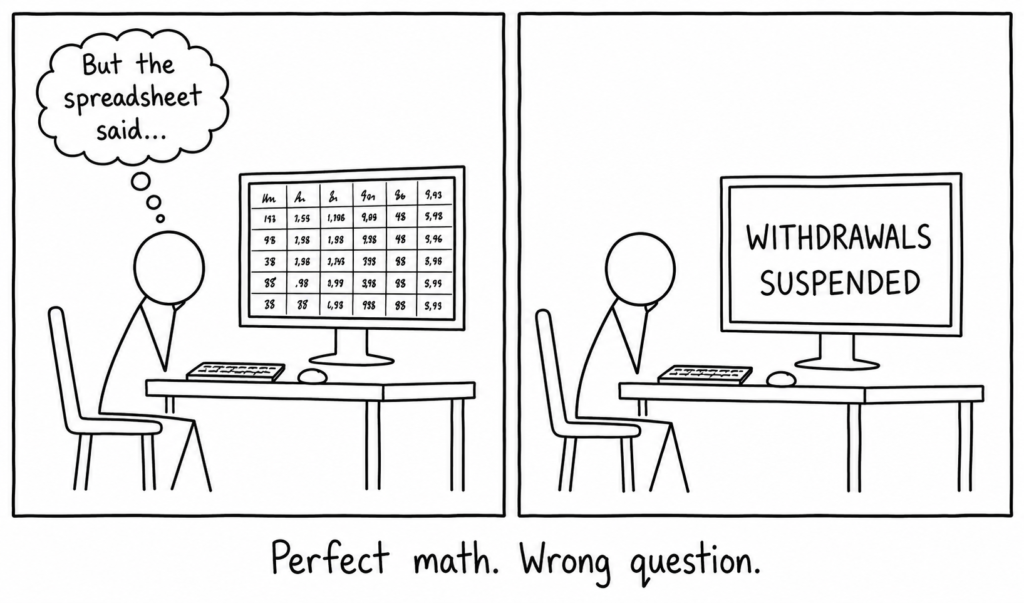
Over the course of several months the platform announced moving mining farms to another location to cut operation costs, which led to temporary suspension of mining service, and later to various types of delays and service disruptions. Over time I realized that most likely I would never see anything out of it.
5 years later the FBI started an investigation against Hashflare founders. Until then I didn’t even know that Hashflare had scammed $577 million from people around the world. My numbers in the spreadsheet were perfect. I just never asked if the company behind it actually existed.
It felt like I had made every possible mistake. But every mistake eliminated one more wrong way to do it.
Hashflare taught me that company research is as important as the numbers.
I wish I had asked who runs the company, what is their reputation and track record. I also noted broader questions for any future investment: financial goals, products, competitors and contracts. The first time I asked these questions was with a $50 stock purchase that changed how I thought about investing entirely. That $50 purchase is where it all started.
Before you invest
Is this platform actually real?
The four questions I never asked about Hashflare. Answer them next time before you put a dollar in.
I never thought to ask this with Hashflare. Google the platform name plus “SEC registration” or “FCA”. If their site lists nothing and search turns up nothing, that is a point worth flagging.
Hashflare had founders I never looked up once. Search them on LinkedIn. Search their name plus “scam” and “fraud”. No real presence outside their own marketing is a flag.
Go to a WHOIS tool and check when the domain was registered. Then search social media. Look for posts older than six months specifically – recent reviews on a scam platform are almost always faked.
This is the one I never thought about until it was too late. Find their terms of service and search for “terminate” and “suspend”. If there is no clear answer for what happens to your money when they go dark, assume the answer is nothing.
One article a week. Real numbers, real mistakes, no finance bro nonsense. If you made it this far, you already know if it’s for you.

3 Comments
Comments are closed.